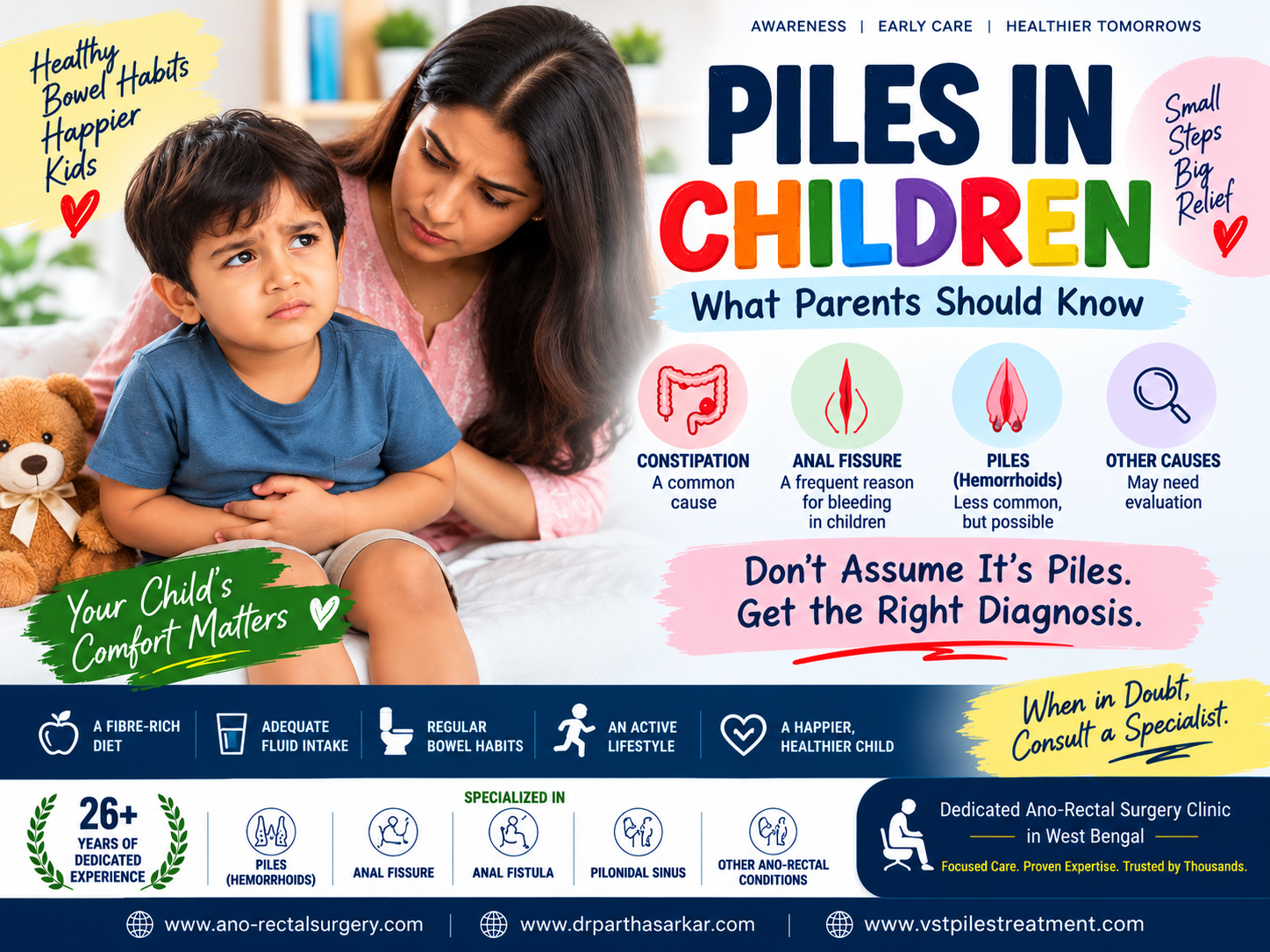
When parents notice blood while their child is passing stool, it can be worrying. Many immediately assume that their child has piles (hemorrhoids). But is it really piles?
The answer is: not necessarily.
Piles can occur in children (very rare before 12 years of age), but they are much less common than in adults. In children, constipation, hard stools and anal fissure are frequent causes of pain or blood during bowel movements. Therefore, proper evaluation is important before assuming that a child has piles.
Why Can Children Develop Piles?
When children suffer from constipation, they may pass large, hard stools and strain repeatedly. Excessive straining can put pressure on the veins around the anus and, in some cases, contribute to hemorrhoids.
Constipation is common among children and may be related to inadequate fibre or fluid intake, stool withholding, changes in diet, or toilet-training difficulties.
However, parents should remember that not every case of bleeding or anal discomfort is piles.
Anal Fissure Is a Common Cause of Bleeding in Children
An anal fissure is a small tear in the skin or lining around the anus. It can occur when a child passes a large or hard stool.
Typical symptoms may include:
-
Bright-red blood on the stool or toilet paper
-
Pain during bowel movements
-
Crying or reluctance to pass stool
-
Constipation and straining
-
Fear of using the toilet
In children, anal fissure is one of the most common explanations for small amounts of bright-red blood associated with bowel movements.
Don’t Ignore Blood in Your Child’s Stool
Parents should not automatically assume that blood in a child’s stool is caused by piles.
Depending on the child’s age and symptoms, bleeding may have different causes, including anal fissure, infection, inflammation or other gastrointestinal conditions. A healthcare professional can determine whether further examination or investigation is required.
Seek medical advice if:
-
Bleeding keeps happening
-
The child has significant pain
-
There is swelling or a lump around the anus
-
The child has persistent constipation
-
There is blood mixed with diarrhoea
-
The stool appears black or tar-like
-
The child looks unusually weak or unwell
-
There is a large amount of blood
Heavy bleeding, fainting, severe pain or a very unwell child requires urgent medical attention.
What Can Parents Do?
The first step is not to panic and not to self-medicate.
If constipation is contributing to the problem, improving bowel habits can be an important part of treatment. Depending on the child’s age, a doctor may recommend appropriate dietary changes, adequate fluids, fibre and treatment for constipation. Medicines, laxatives or rectal treatments should be used in children only according to appropriate medical advice.
Encouraging children to develop regular, comfortable bowel habits can also help prevent repeated constipation and straining.
When Should a Specialist Be Consulted?
Persistent bleeding, recurrent anal pain, swelling, discharge or symptoms that do not improve with appropriate constipation management should be evaluated by a doctor.
A proper diagnosis is particularly important in children because piles, fissure and other anorectal conditions can have overlapping symptoms.
Specialized Ano-Rectal Care in Kolkata
With more than 26 years of experience in ano-rectal diseases, Dr. Partha Sarkar provides specialized evaluation and treatment for conditions involving the anus and rectum, including:
-
Piles (Hemorrhoids)
-
Anal Fissure
-
Anal Fistula
-
Pilonidal Sinus
-
Recurrent and complex ano-rectal conditions
If your child experiences bleeding, pain or difficulty passing stool, don’t simply assume that it is piles.
Find the cause. Get the right diagnosis. Choose appropriate treatment.
For more information: