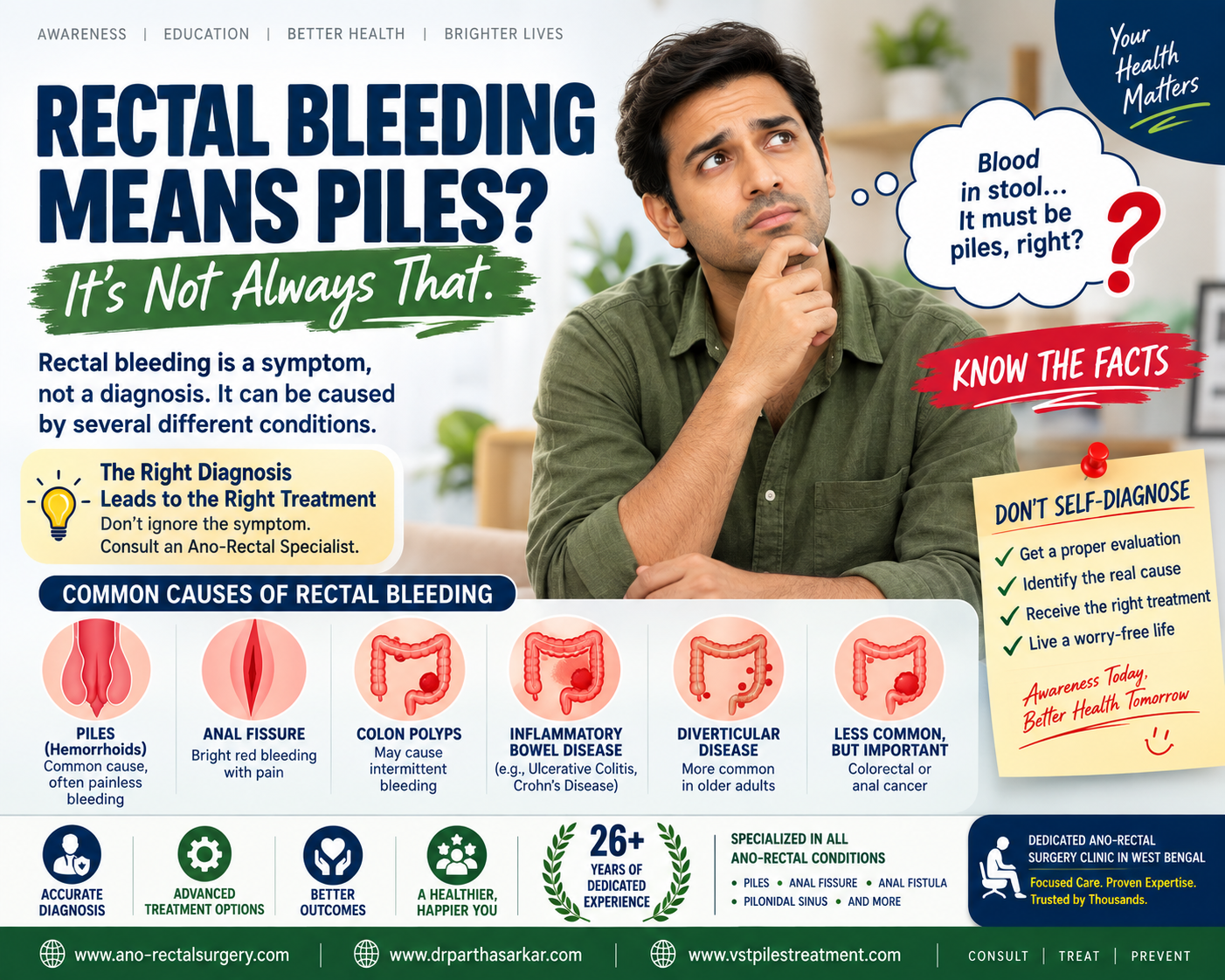
Seeing blood after a bowel movement can be frightening. For many people, however, the first thought is, “It must be piles.” While piles (hemorrhoids) are indeed a common cause of rectal bleeding, rectal bleeding does not always mean piles.
Rectal bleeding is a symptom that can have several different causes. Identifying the actual cause is important because the right treatment depends on an accurate diagnosis.
What Can Cause Rectal Bleeding?
Bright-red blood noticed on toilet paper, on the surface of the stool, or in the toilet bowl can occur due to several anorectal conditions.
Common causes include:
-
Piles (Hemorrhoids)
-
Anal fissure
-
Constipation and hard stools
-
Inflammation of the rectum
-
Colon polyps
-
Inflammatory bowel disease
-
Diverticular disease
-
Less commonly, colorectal or anal cancer
Medical guidelines specifically caution against automatically assuming that rectal bleeding is caused by hemorrhoids. Persistent bleeding may require further investigation to identify its actual source.
Piles and Anal Fissure Can Look Similar
One of the most common reasons for confusion is the similarity between piles and anal fissure.
Piles are swollen veins in the anus or lower rectum and can cause painless bright-red bleeding, particularly with internal hemorrhoids.
An anal fissure, on the other hand, is a small tear in the anal lining. It commonly causes sharp or burning pain during bowel movements along with bright-red bleeding.
Therefore, simply seeing blood does not tell you which condition is responsible.
Don’t Self-Diagnose Rectal Bleeding
It is tempting to assume that bleeding is “just piles” and start using over-the-counter medicines without consulting a doctor. This can sometimes delay the correct diagnosis.
A specialist may consider your symptoms, medical history and perform an appropriate examination. Depending on your age, symptoms and risk factors, additional investigations may sometimes be necessary.
The American Society of Colon and Rectal Surgeons recommends further evaluation when there is no obvious anorectal source of bleeding or when symptoms suggest another gastrointestinal condition.
When Should You See a Doctor?
Do not ignore rectal bleeding, especially if it is:
-
Recurrent or persistent
-
Heavy or increasing
-
Associated with abdominal pain
-
Accompanied by a change in bowel habits
-
Associated with unexplained weight loss or weakness
-
Accompanied by dizziness or fainting
-
Occurring despite previous piles treatment
Heavy or continuous bleeding, particularly with dizziness, fainting or other signs of significant blood loss, requires urgent medical attention.
The Right Diagnosis Leads to the Right Treatment
The message is simple:
Rectal bleeding means something is bleeding. It does not automatically mean piles.
Piles may be the cause, but an anal fissure or another condition could also be responsible. Getting the correct diagnosis at the right time can help ensure appropriate treatment and prevent unnecessary anxiety or delay.
Specialized Ano-Rectal Care in Kolkata
With more than 26 years of experience in ano-rectal diseases, Dr. Partha Sarkar provides specialized evaluation and treatment for piles, anal fissure, fistula, pilonidal sinus and other anorectal conditions.
If you experience rectal bleeding, don’t simply assume that it is piles.
Get the cause identified. Get the right treatment.
For more information: